How Talent And Technology Together Supercharge Factory Productivity
Read Time: 9 Min
807 Views
Why this matters now: the productivity imperative
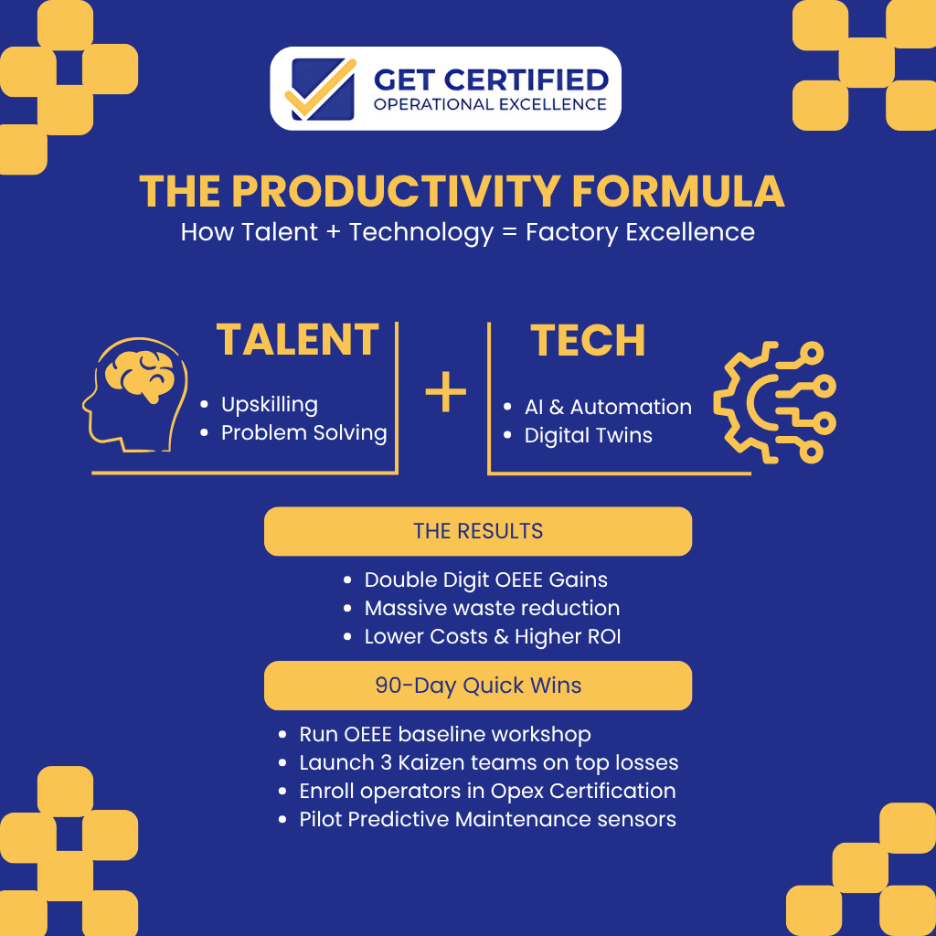
Factories are no longer just about machines and maintenance manuals. Recent industry work shows that when companies invest in both their people and digital technology, the results are dramatic: boosted productivity, big waste reductions and measurable OEE improvements. In one large programme, pilot sites reported strong gains in productivity and safety — and several factories saw double-digit OEE increases and significant reductions in waste.
Put simply: technology unlocks potential, but people convert potential into performance.
Talent first: why frontline workforce investment is an OEE multiplier
Frontline workers are the ones who keep processes running, spot the niggles that turn into breakdowns and know where waste lives on the shop floor. When you invest in upskilling, leadership development and a problem-solving culture, you don’t just get better engagement — you get measurable operational improvements. In the Unilever example, focused talent programmes across sites produced consistent productivity and waste-reduction gains and improved OEE across the board.
What to prioritise:
Practical technical training (PLC, machine diagnostics, data interpretation).
Problem-solving skills (root cause analysis, Kaizen, 5 Why).
Leadership development for frontline supervisors to sustain improvements.
If you want a structured certification route to build those capabilities in-house, the OpEx Certification Institute offers practitioner-to-master OpEx certifications that cover the exact tools and leadership behaviours needed to run Kaizen, 5S, SMED and hold improvements. Their P-OpEx practitioner level is designed so front-line teams can lead fast problem solving and sustain gains.
Technology second: how AI, automation and digital twins raise the ceiling
Technology isn’t a replacement for people — it amplifies them. Smart sensors, robotics and AI remove repetitive tasks and provide real-time insight. Digital twins let engineers test changes in a simulated plant before they touch production. The result: fewer stoppages, better scheduling and more predictable OEE gains.
Examples of outcomes you can expect when technology is implemented alongside talent:
More time for operators to perform higher-value tasks (automation + reskilling).
Unilever’s experience: sites that paired digital tools with comprehensive training freed up operators for higher-value activities and saw marked improvements in engagement and performance.
The combined result: real improvements in OEE, waste and cost
When talent and tech align, the business wins:
OEE climbs because availability, performance and quality all improve. In the Unilever programme the average OEE improvement was notable across multiple sites.
Waste falls — some sites recorded huge reductions in packing and production waste, driving cost savings and sustainability wins.
Engagement and absenteeism improved where people were put at the heart of the transformation, which lowers hidden labour and quality costs.
That’s operational efficiency you can measure on the P&L and on sustainability KPIs.
Practical roadmap: how to start (and scale) a talent + tech productivity plan
Baseline OEE and loss mapping
Identify where availability, speed and quality losses are happening. Use simple visual boards and data from PLCs/SCADA as a start.
Spot quick wins (SMED, 5S, focused Kaizen)
Run rapid events with mixed teams of operators, maintenance and supervisors to capture immediate reductions in changeover time and small breakdowns.
Upskill the frontline
Invest in role-specific technical training and problem-solving skills so operators can diagnose and fix more issues without always calling maintenance.
Introduce technology pragmatically
Start with low-friction automation and analytics that give immediate forewarning (predictive maintenance, sensor analytics, basic AI alerts).
Scale through leadership and governance
Create pillar teams and steering, backed by training for leaders so improvements stick and spread across shifts and plants.
Measure, celebrate, repeat
Track OEE, waste per ton, and cost per unit, and make successes visible to the whole plant.
If you’d like a ready-made training & certification path for steps 3 and 6, OpEx Certification provides tiered programmes designed for practitioners, specialists and masters in Operational Excellence. These map directly onto the skills needed for shop-floor problem-solving and sustainable systems.
Why partner with an Operational Excellence consultancy like Lean Dimension (LDI)?
Operational transformations fail when you only do the tech or only do the training. Lean Dimension takes a humanistic “Operational Excellence 2.0™” approach — they combine technical systems change with applied psychology to get employees bought in and delivering sustainable outcomes. Their model focuses on empowering people so they become the factory’s most valuable asset — not an afterthought. That blend of emotional and technical capability is exactly what creates repeatable improvements at scale.
When to bring LDI in:
You need help designing culturally sensitive roll-outs across multiple sites.
You want coaching for leaders to sustain behavioural change.
You need a blended plan (coaching + technical training + targeted automation) rather than standalone tech projects.
Book an exploratory chat with LDI to map the people and process work that will make your automation and AI pay off.
How certification accelerates durable capability (and why it’s a smart ROI)
Certified programmes give your team a shared language and methods to identify, prioritise and eradicate losses — leadership, loss intelligence, loss eradication and prevention are the backbones of mature OpEx systems. The OpEx Certification Institute’s multi-level pathway (P-OpEx → S-OpEx → M-OpEx) is explicitly designed to scale from front-line practitioners to masters who can build self-sustaining OpEx systems inside a plant or across multiple sites. That’s exactly the ladder you need if your goal is to embed Operational Efficiency rather than run one-off projects.
Quick checklist: 7 actions to lift OEE and cut waste in the next 90 days
Run a one-day OEE baseline workshop with cross-shift leaders.
Launch three Kaizen teams focused on top 3 losses.
Start a 5S blitz on the highest-impact production line.
Enrol 6 operators on a P-OpEx practitioner module (or equivalent in-house course).
Pilot a predictive-maintenance sensor on one critical machine.
Introduce a daily visual management meeting to review OEE and action items.
Celebrate wins and publish results plant-wide.
Want that as a downloadable checklist or a one-page OEE diagnostic? I can create it for you as a gated lead magnet.
FAQs
What is OEE and how is it calculated? OEE (Overall Equipment Effectiveness) measures how much of your manufacturing time is truly productive by multiplying Availability × Performance × Quality. It’s the industry standard for diagnosing lost production and prioritising improvement actions.
What are the most common causes of low OEE? Low OEE usually comes from three buckets: downtime (availability losses), slow cycles or reduced speed (performance losses), and defects/rework (quality losses). Common implementation OEEE mistakes include comparing dissimilar lines or using OEE without contextual loss mapping.
How do you improve OEE quickly (practical first steps)? Start with an OEE baseline and simple loss-mapping, run focused Kaizen (SMED / 5S / quick changeover) events on the top 3 losses, upskill operators to diagnose minor faults, and pilot predictive sensors on critical assets. These low-friction moves deliver measurable OEE gains fast.
Should we upskill frontline workers before or after automation? Upskill first. Evidence from major pilots shows technology pays off only when people have the skills and problem-solving culture to use it — otherwise automation locks in old problems. Invest in technician and supervisor capability before wide automation roll-outs.
What is a digital twin and is it worth the investment for a factory? A digital twin is a live simulation of equipment or a line that lets you test changes or schedules before implementation. It’s worth it where the cost of downtime or rework is high and where you want to safely trial layout, process or scheduling changes. Start with smaller pilots to prove value.
How can AI and predictive maintenance reduce unplanned downtime? AI analyses sensor and operational data to spot patterns that predict impending faults. Predictive maintenance can reduce unplanned stoppages, speed diagnosis and free operators for higher-value work — raising availability and overall OEE.
How do I upskill frontline workers for Industry 4.0 without disrupting production? Use bite-sized modules, on-the-job coaching, role-based learning (operator, technician, supervisor) and digital micro-learning. Pair training with immediate Kaizen projects so learning translates into visible, measurable changes on the line.
What recognised certifications exist for Operational Excellence practitioners? There are tiered OpEx certifications (practitioner → specialist → master). The OpEx Certification Institute offers P-OpEx, S-OpEx and M-OpEx pathways that map directly to shop-floor methods (5S, Kaizen, SMED) and leadership skills for scaling OpEx.
How soon will we see ROI from OpEx training or digital upgrades? Timescales vary by scope, but large pilots combining talent and tech have reported double-digit productivity gains and rapid waste reductions within months. For example, multi-site pilots have shown average productivity improvements in the high-teens to 20s percent. Use a 90-day quick-win plan to capture immediate value while you scale.
When should we hire an Operational Excellence consultant instead of doing it in-house? Bring consultants in when you need multi-site roll-out expertise, change-leadership coaching, or a blended people+tech plan. An experienced OpEx consultancy speeds adoption, avoids common traps and builds internal capability — especially useful if you lack change managers or lean coaches.
What KPIs should I track alongside OEE for a full picture of factory health? Track waste per tonne, first-pass yield, mean time between failures (MTBF), mean time to repair (MTTR), changeover time (SMED), and cost per unit. These combined metrics tell you whether improvements are sustainable and truly reducing costs.
How can I make frontline employees my factory’s most valuable asset? Treat them as problem solvers: map losses with them, certify them with practitioner-level OpEx training, give them time and tools for Kaizen, and pair tech pilots with clear upskilling paths. The biggest wins come where talent development and digital tools are designed together.
0
Tags
EducationalLean DimensionLean Six SigmaLoss IntelligenceTalentTechnology
Every manufacturing leader today hears the siren call of artificial intelligence (AI) and automation. The potential rewards - predictive maintenance...
Lean manufacturing and Lean Six Sigma are proven strategies to cut waste and defects in production. In UK factories, they promise sharper processes,...